Warning signs are supposed to clear things up, but sometimes they do the exact opposite. From entrances you somehow can’t enter to “no smoking unless you’re on fire,” these confusing messages make everyday situations feel like riddles. Here are some perfect examples where the wording raised more questions than answers.
1. “Do Not Enter, Entrance Only”

This sign manages to cancel itself out in one sentence. Drivers approaching it are left wondering if they should obey the red warning or trust the promise of an entrance. Either way, someone’s turning around confused.
2. “No Smoking Unless You’re On Fire”

A dramatic loophole no one asked for. The sign tries to be funny or emphatic, but ends up sounding like an emergency-only exception for smoking. Let’s hope no one ever qualifies to use it.
3. “Left Curve Ahead / Keep Right”

This combination feels like a contradiction in motion. One sign warns of a left curve, while the other insists you stay right, leaving drivers puzzled about which way the road actually goes.
4. “STOP / No Stopping Anytime”

A stop sign immediately followed by a rule forbidding stopping at any time makes the simple act of obeying the law feel impossible. You have to stop, but also… you can’t? Good luck.
5. “No Left Turn… But Also Only Left?”

This intersection feels like a psychological test. One sign bans left turns completely, while the diagram next to it directs traffic left or straight only. Add a forest of traffic lights and a separate bike signal and you get a crossroads that makes everyone question their driving skills.
Trending on Wealth Gang


6. The “Everything Is Montreal” Intersection

When every sign points to a different version of Montreal, navigation becomes a guessing game. It technically gives directions, but none that actually help you choose a street.
7. The “Road Closed… Obviously” Flooded Sign

The sign warns that the road is closed due to flooding, but the water is already covering it. If you can read it, you are already in trouble.
8. The “No Left Turn but Only on Sundays at Strange Hours” Sign

You cannot turn left except from 5 PM to 2 AM on Sundays. It requires drivers to check the day, the hour and their sanity.
Sign up for our newsletter
9. The “One Way but the Traffic Light Disagrees” Confusing Setup

The sign says one way to the right, while the traffic light arrow points left. Drivers must choose which rule they want to break.
10. The “Height Limit That Only Applies Later” Sign

The sign warns of a 2.0 meter restriction but only after 150 meters. Drivers must decide if they trust the measurement or take their chances.
11. The “Stop Sign With Too Much Extra Information” Combo

A simple stop becomes complicated when followed by many additional rules. Stopping is easy but understanding the rest feels like studying for a test.
12. The “Entrance Only Doors That Do Not Make Sense” Situation

Both doors say entrance only even though one does not function as an entrance. A perfect welcome for customers who enjoy confusion.
13. The “Actually Stop at Stop Signs” Police Reminder

The sign tells drivers to actually stop at stop signs. It sounds less like a rule and more like a disappointed parent talking.
14. The “Push or Pull or Neither” Door Sign

The sign mixes messages like don’t pull, push only and don’t push, pull only. It turns a simple door into a challenge.
15. The “Evacuation Route That Leads Into a Dead End” Pair

The top sign says not a through street. The bottom sign says evacuation route. It suggests evacuating directly into nowhere.
16. The “Choose Your Own Parking Rules” Stack

No parking at one time. No waiting at another time. Passenger loading at night. One hour parking somewhere else. It is not signage. It is a puzzle.
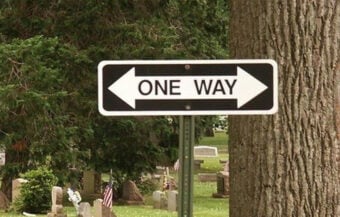
17. The “One Way in Two Directions” Cemetery Sign

The sign points left and right even though it says one way. In a cemetery, the symbolism is a little too strong.
18. The “Sign Not in Use That Is Clearly in Use” Message

The bright red sign says sign not in use while being fully installed on a post. It defeats its own message instantly.